
Home › Guides › LS fuel system, E85 & injectors
LS fuel system, E85 & injectors
What the fuel system needs for an LS swap, from stock power to E85 and boost, with a worked sizing example. Or size yours with the fuel system calculator.
Last updated
How we put this guide together
187 of the 2,012 LS swap questions we pulled from forum threads were about fuel: what pressure an LS needs, whether an old carbureted tank and lines will work, what size injectors and pump to run, and what changes for E85. The numbers below follow standard injector and pump sizing math, cross-checked against published injector charts. We ran one example engine through every step so you can see the math.
Step 1: Know what an LS fuel system has to do
An LS doesn't run on a carburetor's fuel pressure.
- Pressure: most LS swaps run about 58 psi (58–60 psi), returnless style. A carbureted small block runs 5–7 psi.
- Hose and fittings: parts-store rubber hose and hose clamps aren't adequate at 60 psi. Use AN hard lines, push-on EFI hose and fittings, or ethanol-safe hose. More: return vs returnless for a swap.
- The stock filter/regulator tops out around 450 hp. Past that, plan on bigger lines and an external regulator.
So if you're coming from a carbureted car, expect the pump, lines and hoses to need changing.
Step 2: Size the injectors
The formula, per injector:
Injector flow (lb/hr) = horsepower × BSFC ÷ number of cylinders ÷ 0.80
BSFC is how much fuel the engine burns per horsepower. The conservative values used for sizing are 0.55 for gasoline, 0.80 for E85 and 1.20 for methanol. The 0.80 at the end keeps the injector at 80% duty so it has room to spare. Some published injector charts use 85% instead and run 30–40% above typical calculators on purpose, so they're the more conservative choice.
Worked example, a 450 hp V8:
| Gasoline | E85 | |
|---|---|---|
| Math | 450 × 0.55 ÷ 8 ÷ 0.80 | 450 × 0.80 ÷ 8 ÷ 0.80 |
| Injector needed at running pressure | 38.7 lb/hr | 56.2 lb/hr |
Adjust for pressure. Injectors are usually rated at 43.5 psi (3 bar) or 58 psi (4 bar), and flow rises with the square root of the pressure. An injector rated at 43.5 psi flows about 15.5% more at 58 psi (√(58 ÷ 43.5) ≈ 1.155). So for our example, at 58 psi you'd look for about 33.5 lb/hr rated at 43.5 psi on gasoline, or 48.7 lb/hr for E85.
Then check the practical details:
- Connector: most LS injectors use USCAR; early trucks use Mini Delphi/Multec 2; LS1/LS6 use Jetronic/Minitimer. Adapters exist.
- Height: there are five height variants. Spacers ("top hats") let taller injectors fit shorter intakes.
- Impedance: factory LS injectors are high impedance (about 12 ohms) and work with the factory computer. Low-impedance injectors (2–4 ohms) need an aftermarket ECU with suitable drivers.
- Buying used LS injectors? Check the flow rating and connector before you buy.
- Don't decap for more flow: removing the pintle cap raises flow but hurts how evenly the injectors match.
Step 3: Size the fuel pump
The pump formula: pump flow (lb/hr) = horsepower × BSFC, then divide by 6 for gallons per hour or by 1.6 for liters per hour.
For our 450 hp example on gasoline (a 255 lph pump covers it): 450 × 0.55 = 247.5 lb/hr, which is about 41 gph or 155 lph. On E85: 450 × 0.80 = 360 lb/hr, about 60 gph or 225 lph.
Two catches:
- Pumps are advertised at free flow, and flow drops as pressure rises. At 58 psi a pump flows less than its box says, so check its flow curve at your pressure.
- Voltage matters. Flow rises with voltage, so check you're getting about 13.5 V at the pump. Wire size sets the voltage drop: see the wire gauge chart.
Step 4: If you're running E85
E85 needs more of everything. Its stoichiometric air-fuel ratio is about 9.7–9.8:1 against gasoline's 14.7:1. How much more fuel that means depends on who you ask:
- At conservative BSFC values (0.80 vs 0.55), E85 needs about 45% more fuel for the same power.
- A common rule of thumb is about 30% more (multiply your gasoline injector size by 1.3).
We size with the higher figure, which is why the example above jumps from 38.7 to 56.2 lb/hr. Use ethanol-safe hose, and pick injectors made with ethanol-resistant materials.
Step 5: Tune it
Any injector change needs a tune with the new injector's flow data and offsets, or the engine will run rich or lean. More: entering injector data in HP Tuners. The tune checklist covers the rest.
Want to skip the math? The fuel system calculator does it for your engine. The injector chart and injector types are below. Spot an error? Tell us.
Injector chart and reference
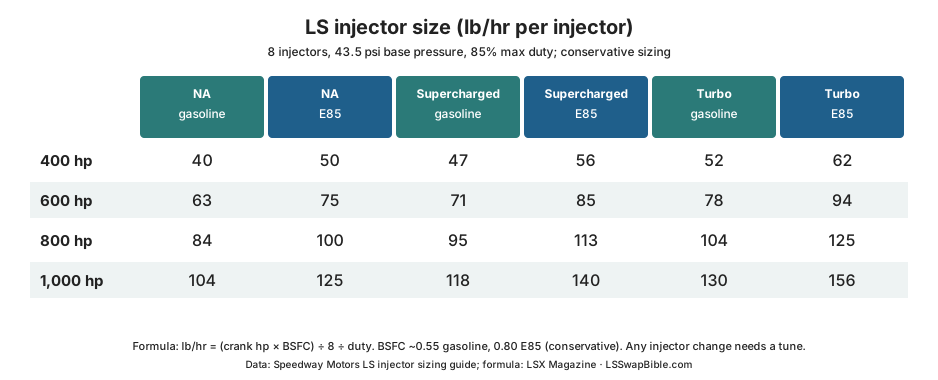
Key facts
- Injector sizing formula (per injector): Min injector flow (lb/hr) = (Gross power × BSFC) ÷ cylinders ÷ max duty (0.80)
- BSFC used for sizing (conservative examples): Gasoline 0.55; E85 0.80; M1 methanol 1.20 lb/hp·hr
- Design duty cycle limit: 80%; some charts use 85% (Specs differ: 80% vs 85%)
- Injector flow vs fuel pressure: Flow scales with the square root of the pressure differential; injectors commonly rated at 43.5 psi (3 bar) or 58 psi (4 bar)
- E85 stoichiometric AFR: ≈9.7–9.8:1 (pure ethanol 9.0:1; gasoline ≈14.7:1)
- Extra fuel needed on E85: ≈45% more fuel for the same power at conservative BSFC values (0.80 vs 0.55) (A common rule of thumb is ~30% (e.g., multiply gasoline injector size by 1.3); the figure depends on the BSFC assumed. Some charts put the E85/gas ratio at ≈1.19–1.25)
- Methanol fuel demand: ≈2.7× gasoline injector flow at typical BSFCs; stoich ≈6.47:1
- LS injector impedance: OEM LS injectors are high impedance (~12 ohm) and work with OEM ECUs; low impedance (2–4 ohm) needs an aftermarket ECU with suitable drivers
- LS injector connectors: USCAR (most), Mini Delphi/Multec 2 (early trucks), Jetronic/Minitimer (LS1/LS6). EV1→EV6 adapters exist
- LS injector heights: Five height variants; spacers ("top hats") let taller-intake injectors (e.g., LS3) fit LS1/LS2/truck manifolds. O-ring thickness covers the 0.036 in intake-bore difference across years (published figures: 38–64.8 mm or 47.4–67 mm)
- Aftermarket injector flow range: ≈330–2,600 cc for street-friendly applications; aftermarket units use ethanol-resistant materials
- Decapped injectors: Removing the pintle cap raises flow but hurts flow matching between injectors
- Tuning: Any injector change requires a tune (flow data/offsets) or the engine runs rich/lean
- LS base fuel pressure: 58 psi (≈58–60 psi) returnless style on most LS swaps
- Fuel pump minimum flow: lb/hr = peak hp × BSFC; gph = lb/hr ÷ 6; lph = lb/hr ÷ 1.6 (Summit example: 500 hp × 0.5 = 250 lb/hr = 41.7 gph = 156 lph)
- Pump flow vs pressure: Pumps are advertised at free flow; flow drops as pressure rises (EFI 35–65 psi); voltage raises flow; check the pump curve and verify ~13.5 V at the pump
- Size to crank horsepower: Size injectors and the pump for flywheel (crank) horsepower, never wheel horsepower: drivetrain loss makes a wheel number undersize everything.
- Supercharger draw counts: On a supercharged build, size for gross engine output including what the blower takes to drive (a big centrifugal can take 160–200 hp at full boost).
- OEM-style fuel module outlet: A GM 3/8 in quick-connect module outlet is enough for up to about 750 flywheel hp.
- DW300 (340 LPH) pump: About 1,075 hp at 40 psi (340 LPH at 13.5 V); from about 1,335 hp at 0 psi down to 745 hp at 100 psi.
- Walbro 450 (F90000274) pump: 465 LPH at 40 psi and 13.5 V, drawing 14.1 A; meant for engines past 750 hp and E85-rated.
- Return line size: Size the return line to flow the pump's full output with at least 3 psi less backpressure than the regulator setting, not to match the feed line.
- Feed line size: From pump to engine, match the pump's outlet port size; one AN size smaller still works on an injected engine.
- Tank-to-pump line: Never make the line from the tank to the pump smaller than the pump's inlet port; bigger is fine.
- Return-style plumbing order: Pump to the rails first, the far ends of the rails to the regulator inlet, and the regulator returns the extra fuel to the tank.
- Boost-referenced regulator: A manifold-referenced regulator adds fuel pressure 1:1 with boost: 10 psi of boost raises fuel pressure 10 psi.
- Rail-to-regulator line: -6AN (3/8 in) to -10AN (5/8 in) between the rails and the regulator, sized to the engine and pump flow.
LS injector types
We may earn a commission when you buy through links on this page.
| Used on | Rail bore | Intake bore | Length | Connector | Notes |
|---|---|---|---|---|---|
| LS3, LS7, LS9, L76, L77, L98, L99, LS4, LSA, LSX, LS2 (some) | 0.533 | 0.551 | 1.95 | USCAR | |
| Truck (LH6, LY5, LY6, LC9, LFA, L98, L20, L21, LC8, LY2, LM4, L96) | 0.533 | 0.551 | 1.915 | USCAR | |
| Truck (L92, LH8) | 0.536 | 0.551 | 1.865 | USCAR | |
| Truck (LM7, LR4, LQ4, LQ9, L33) | 0.537 | 0.551 | 1.865 | Mini Delphi (Multec 2) | |
| LS2 | 0.533 | 0.551 | 2.0 | USCAR | |
| LMG (E85) | 0.533 | 0.551 | 2.0 | USCAR | |
| L59 (E85) | 0.533 | 0.551 | 2.08 | USCAR | |
| LS1, LS6 | 0.537 | 0.551 | 2.65 | Jetronic / Minitimer | LS1/LS6 67 mm conflicts with article text "38mm to 64.8mm" |
| LS3, L99, L76, LS7 (shorter body than LS1/LS6 injectors) | EV6/USCAR | FAST Precision-Flow LS3/L99/L76/LS7-Type Fuel Injectors (set of 8) (30397-8). 39 lb/hr (409.5 cc/min) at 58 psi. | |||
| LS3, LS7, LS9, L76: 2010-15 Camaro, 2014-15 Camaro Z/28, 2008-13 Corvette, 2006-13 Corvette Z06, 2014-17 SS, 2008-09 G8 | GM / Bosch LS3/LS7/LS9/L76 Fuel Injector (Bosch 0 280 158 051) (12576341). 36 lb/hr @ 43.5 PSI; 42 lb/hr @ 58 PSI. | ||||
| Universal high-flow performance / forced-induction use | Bosch square (EV1/Jetronic) | Bosch EV14 980cc Fuel Injector with Extended Nose (0 280 158 040). 980cc/min (92.5 lb/hr) @ 3.0 bar; 1150cc (109.5 lb/hr) @ 4 bar. |
LS injector part numbers and flow rates
The 8-digit GM number is printed on the side of each injector. The tune's injector flow data has to match the injectors installed, or fueling is off everywhere. Gen III trucks ran a return-style rail at 55–62 psi through 2003; most trucks went returnless in 2004 (the L59 flex-fuel 5.3 kept a lower-pressure return rail through 2004). Returnless rails hold a constant pressure.
| GM part # | Used on | Flow | Type | Checked |
|---|---|---|---|---|
| 25317669 also 25320287 | 1999 4.8 and 5.3 trucks | 21.8 lb/hr at 58 psi | Multec 2 (Gen III truck) | Cross-checked |
| 25317670 also 25320288, 25323974 | 1999–2000 6.0; 2000 4.8 and 5.3 trucks | 24.8 lb/hr at 58 psi | Multec 2 (Gen III truck) | Cross-checked |
| 25317628 | 2001–2007 4.8, 5.3 and 6.0 (LR4, LM7, LQ4, LQ9, LM4, L33) | 25.2 lb/hr at 58 psi | Multec 2 (Gen III truck) | Cross-checked One parts list rates the LQ4 version at 24.8 lb/hr. |
| 12554271 | 1997–1998 LS1 | 29.6 lb/hr at 58 psi | EV1 (LS1/LS6) | Specs differ Specs differ: 29.6 lb/hr in two lists, 26.2 lb/hr in another. Stock 1998 F-body tunes we checked are scaled like the 30 lb/hr injector. |
| 12555894 | 1999–2000 LS1 | 27.3 lb/hr at 58 psi | EV1 (LS1/LS6) | Cross-checked |
| 12561462 | 2001–2004 LS1 and LS6 | 30 lb/hr at 58 psi | EV1 (LS1/LS6) | Cross-checked |
| 12580426 | 2002–2004 5.3 L59 flex fuel (return-style rail) | 33 lb/hr at 50 psi | EV6, taller than non-flex truck injectors | Cross-checked Rated at the lower 50 psi flex-fuel rail pressure. |
| 25326903 | 2005–2007 5.3 L59 flex fuel (returnless rail) | 36.6 lb/hr at 58 psi | EV6, taller than non-flex truck injectors | Specs differ Specs differ: 36.6 lb/hr at 58 psi in two lists; another lists this number as 33 lb/hr at 50 psi. |
| 12580681 also 19421333 | Gen IV trucks and cars: LY2, LY5, LY6, LH6, L76 truck, LFA, L92, LS4 | 30 lb/hr at 58 psi | EV6 / USCAR | Cross-checked Listed as 29 lb/hr on one spec sheet and 30 lb/hr on another. |
| 12613411 | 2010–2017 4.8 and 5.3 (L20, LC9, LH9, LMF, LMG, LZ1) | 36 lb/hr at 58 psi | EV6 / USCAR | Cross-checked |
| 12613412 | 2010+ flex-fuel engines (L96). Drop-in for 4.8/5.3/6.0 non-flex rails (same height) | 50 lb/hr at 58 psi | EV6 / USCAR | Cross-checked Popular cheap upgrade for truck engines. Needs an EV6 plug or adapters on Gen III harnesses. |
| 12609749 | 6.0 and 6.2 heavy-duty truck engines (L94, L9H) | 50 lb/hr at 58 psi | EV6 / USCAR | Specs differ Specs differ: 50 lb/hr in one list, 54 lb/hr in another. Get the flow data from your injector supplier before you tune. |
| 12576341 | LS3, L76, L99 and LS7 | 42 lb/hr at 58 psi | EV6 / USCAR | Cross-checked Also rated 36 lb/hr at 43.5 psi. |
| 12569113 | LS2 (car and truck) | 34 lb/hr at 58 psi | EV6 / USCAR | Verify Verify before use. |
| 12639221 | L77 | 42 lb/hr at 58 psi | EV6 / USCAR | Verify Verify before use. |
| 12598646 | LSA and LS9 | 52 lb/hr at 58 psi | EV6 / USCAR | Verify Verify before use. |
Flow changes with the square root of pressure: flow at new psi = rated flow × √(new psi ÷ rated psi). Example: 25.2 lb/hr at 58 psi is about 23.8 lb/hr at 52 psi. We checked these against each other and against the injector flow tables in stock calibrations from our tune library. Size new injectors with the injector calculator.
GM MAF sensors: airflow at three frequencies
A GM MAF sensor reports airflow as a frequency. Comparing grams per second at the same frequency shows how different two sensors are. Any GM MAF can work on any LS, as long as the MAF table in the tune is replaced with the curve for the sensor and housing you actually run.
| GM part # | Used on | g/s at 3,000 Hz | g/s at 6,000 Hz | g/s at 12,000 Hz | Checked |
|---|---|---|---|---|---|
| 15904068 ACDelco 213-4160 | 1999–2007 GM trucks and SUVs with gas V8s (Silverado, Sierra, Avalanche, Tahoe, Yukon), Trailblazer 5.3, Hummer H2 5-wire, built-in air temp sensor | 8.063 | 55.016 | 453.688 | Cross-checked Same curve in more than 100 stock truck tunes we checked. Some lists add Corvette years to this part number, but the stock Corvette tunes we checked use a different curve. |
| 25179711 ACDelco 213-353 | 1998–2002 Camaro and Firebird LS1 3-wire, separate air temp sensor | 10.43 | 63.875 | 439.203 | Cross-checked Same curve in 42 F-body tunes we checked. 1997–2000 Corvette tunes use a slightly different curve, so don't assume the Corvette calibration is identical. |
| 15926193 ACDelco 213-4221 | 2003–2007 Express and Savana vans, 4.8/5.3/6.0 Smaller housing than the truck sensor | 4.961 | 39.492 | 361.695 | Cross-checked Same curve in the stock-based van tunes we checked. |
| 25341604 ACDelco 213-1150 | 2001–2004 Corvette Z06 LS6, 2003–2006 SSR | 8.383 | 56.398 | 470.828 | Verify Verify before use. |
HP Tuners shows the P01/P59 MAF table in lb/hr: multiply g/s by 7.937. The housing diameter is part of the calibration, so a sensor moved into a different tube needs its own curve. More on MAF and speed density in tuning fundamentals.
Fuel questions
- What size injectors do I need for my LS?
- Best fuel pump for an LS swap
- What size fuel pump do I need?
- How much more fuel does E85 need?
- What fuel tank, pump, and line setup works for an LS swap in a 1972 C10?
- How do you plumb a Corvette filter/regulator into an LS swap fuel system?
- Can I put an in-tank EFI fuel pump in the original in-cab 67-72 tank instead of running an inline pump?
- Can an aftermarket under-bed gas tank work for an LS swap in a 72 C10?
- What do I need for fuel delivery on an LS3 swap starting from scratch with a fuel cell: pump, filter, regulator, surge tank?
- Is a Walbro 255 lph fuel pump enough for a 440hp fuel-injected build?